

Cultured Meat Market Growth Trends and Industry Forecast 2033
cultured meat market
Cultured meat market is growing rapidly, driven by sustainable food demand, biotechnology advances, and ethical concerns over traditional livestock farming.
LONDON, UNITED KINGDOM, May 27, 2026 /EINPresswire.com/ -- The cultured meat market is emerging as a major innovation within the global food and biotechnology industry. Cultured meat refers to real animal meat produced through cell culture technology without the need for traditional livestock farming. This method grows animal cells in controlled environments to replicate the taste, texture, and nutritional value of conventional meat. The approach is gaining traction due to increasing demand for sustainable food systems, rising environmental concerns, and rapid advancements in biotechnology.
Download Your Free Sample & Explore Key Insights: https://www.persistencemarketresearch.com/samples/22042
Market Size and Growth Outlook
The global cultured meat market size is projected to reach USD 865.3 million in 2026 and is expected to grow significantly to USD 2,682.1 million by 2033. This reflects a strong compound annual growth rate (CAGR) of 17.5 percent during the forecast period. Between 2020 and 2025, the market also recorded steady growth of 13.4 percent, driven by early-stage commercialization and increasing investments in alternative protein technologies. The outlook remains highly positive as production scales and regulatory approvals expand globally.
Market Drivers
The cultured meat market is primarily driven by rising consumer demand for sustainable and ethical food alternatives. Concerns over greenhouse gas emissions, land use, and animal welfare are encouraging both consumers and governments to support alternative protein sources. Additionally, advancements in cell culture technology and bioprocessing are improving production efficiency and reducing costs. Foodservice partnerships are also playing a key role by allowing companies to test products in controlled environments and gather consumer feedback before large-scale retail launches.
Regional Insights
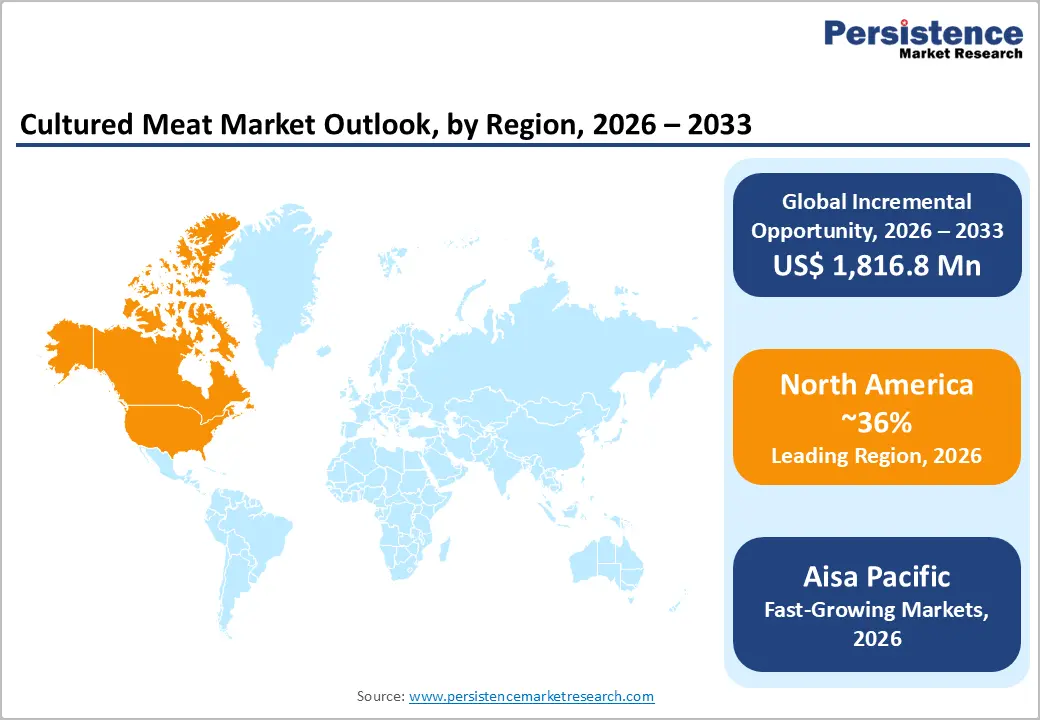
North America leads the cultured meat market due to strong regulatory clarity, significant venture capital investment, and a well-developed biotechnology ecosystem. The United States has established a dual regulatory framework through the FDA and USDA, which has enabled early commercialization of cultured meat products. Asia Pacific is the fastest-growing region, driven by strong government support, rising urbanization, and increasing protein demand. Countries such as Singapore and China are actively promoting alternative protein innovation, while Japan and South Korea are strengthening regulatory frameworks to support future growth.
Poultry and Pork Segment Trends
Poultry dominates the cultured meat market by source due to early regulatory approvals, lower production costs, and faster cell growth rates. Cultivated chicken products have already reached commercial markets, especially in Singapore and the United States. Pork is emerging as the fastest-growing segment, supported by high consumption levels in Asia and disruptions in traditional pork supply chains caused by diseases such as African swine fever. Cultivated pork fat and hybrid meat products are also gaining attention for their scalability and improved taste profiles.
Get Custom Insights Designed for Your Businecss: https://www.persistencemarketresearch.com/request-customization/22042
End Use and Application Trends
Burgers represent the leading end-use segment in the cultured meat market due to their familiarity and ease of production. Ground meat structures used in burgers are easier to replicate using current cell culture technologies, making them ideal for early commercialization. Cultured meat burgers are widely used in foodservice trials and pilot programs, particularly in the United States. Their popularity is driven by consumer curiosity, sustainability awareness, and convenience, making them a key entry point for market expansion.
Regulatory Landscape and Consumer Adoption
The regulatory environment for cultured meat is evolving across major regions. Singapore became the first country to approve cultured chicken, followed by approvals in the United States and Israel for select products. However, regulatory uncertainty still exists in regions such as the European Union, where approval processes for novel foods are lengthy. Consumer acceptance is gradually increasing, with nearly half of surveyed consumers expressing willingness to try cultured meat. However, concerns regarding naturalness, safety, and taste perception continue to influence adoption rates.
Market Segmentation
By Source
Poultry
Beef
Pork
Seafood
Duck
By End-user
Nuggets
Burgers
Meatballs
Hot Dogs
Others
By Distribution Channel
Business to Business
Business to Consumers
Hypermarkets/Supermarkets
Convenience Stores
Food and Drink Specialty Stores
Online Retail
By Region
North America
Europe
East Asia
South Asia & Oceania
Latin America
Middle East & Africa
Competitive Landscape
The cultured meat market is highly competitive and innovation-driven, with several startups and food technology companies leading development efforts. Key players include UPSIDE Foods, GOOD Meat, Mosa Meat, Aleph Farms, and Believer Meats. These companies are focusing on scaling production, reducing costs, and achieving regulatory approvals. Strategic partnerships with foodservice providers and investors are also helping accelerate commercialization and improve market visibility.
Checkout Now & Download Complete Market Report: https://www.persistencemarketresearch.com/checkout/22042
Recent Developments
Recent developments in the cultured meat industry highlight growing investment and technological progress. Companies are securing funding to scale production facilities and develop serum-free media solutions. Pilot plants and commercial-scale facilities are being established in regions such as Europe, Singapore, and the United States. Partnerships between biotechnology firms and food manufacturers are also improving production efficiency and supporting the transition toward large-scale commercialization.
Future Outlook
The future of the cultured meat market appears promising as technological advancements and regulatory clarity continue to improve. Increasing investments in bioreactor technology and cell culture media are expected to reduce production costs significantly. As consumer awareness grows and sustainability concerns intensify, cultured meat is likely to become a mainstream protein source over the next decade, supported by strong global demand and innovation in food biotechnology.
Read Related Reports:
Natural Food Preservatives Market: The natural food preservatives market is set to grow from US$598.3 Mn in 2026 to US$986.2 Mn by 2033, driven by clean-label demand worldwide trend.
Invert Sugar Syrups Market: The invert sugar syrups market to reach US$ 1,267.1 million by 2033, growing at a 4.3% CAGR from 2026, driven by food and beverage demand.
Persistence Market Research
Persistence Market Research Pvt Ltd
+1 646-878-6329
email us here
Visit us on social media:
LinkedIn
Instagram
Facebook
YouTube
X
Legal Disclaimer:
EIN Presswire provides this news content "as is" without warranty of any kind. We do not accept any responsibility or liability for the accuracy, content, images, videos, licenses, completeness, legality, or reliability of the information contained in this article. If you have any complaints or copyright issues related to this article, kindly contact the author above.
